Pink’s Travel Tip #4: The rule of HAHU
Published January 1st, 2009
Pink’s Travel Tips — Intro
Pink’s Travel Tips — Tip #1
Pink’s Travel Tips — Tip #2
Pink’s Travel Tips — Tip #3
Pink’s Travel Tips — Intro
Pink’s Travel Tips — Tip #1
Pink’s Travel Tips — Tip #2
Pink’s Travel Tips — Tip #3
Thanks for reading in 2008. Here’s to a peaceful and prosperous 2009.
Â
Today’s Wall Street Journal has a terrific story about Igor Panarin, a respected Russian scholar and policy guru who’s peddling an audacious prediction:
The United States of America will be no more by 2010.
And it won’t be Russian missile doing us in. We’ll rot from the inside, says Panarin. (Kinda like the Soviet Union? — Ed.) As the Journal sums up:
“[M]ass immigration, economic decline, and moral degradation will trigger a civil war next fall and the collapse of the dollar. Around the end of June 2010, or early July, he says, the U.S. will break into six pieces — with Alaska reverting to Russian control.”
What will the Not-So-United States look like? Check out the map below — and get ready to change your drivers license to The Texas Republic, which will be part of Mexico.
I’m not OK.Â
You’re not OK.Â
Therefore, I’m OK.
Read more here.
(Via PSFK)Â
Seth Schiesel, the must-read video game critic at the NY Times offers a year-end recap that included this item, which offers advice for businesses beyond the gaming world:
“This year CCP of Iceland . . . invited the more than 200,000 players of Eve Online to vote for nine representatives from around the world to convey their concerns and suggestions about the game to the company. That alone was innovative. Then the company flew them to Iceland to sit down for a few days with the game’s developers. The company has committed to repeating the process about every six months, which makes this an idea that ought to spread beyond the game world. Maybe Microsoft should allow Windows users to vote for an officially recognized gripe committee. Maybe the airlines could have their chief executives sit down with an elected panel of frequent flyers twice a year. Hey, who says games can’t make the world a better place?”
Inspired no doubt by Travel Tip #3, the New York Times offers its very own guide to airport dining.
Some old standbys make the list. Paschal’s in Altanta’s Hartsfield-Jackson is there, as it should be. (Nothing like collard greens to take the sting out of a delay.) So is the fantabulous La Carreta, which is about the only thing I like about the Miami Airport. And, yes, I do eat at Billy Goat Tavern in O’Hare, though more for nostalgia than for nourishment. (Somehow, though, I’d missed Cousin’s Bar-B-Q at DFW, which I’ll check out next time American Airlines strands me in Dallas.
In all, reporter Matt Gross did a nice job with the piece. You can read the whole thing here. Â
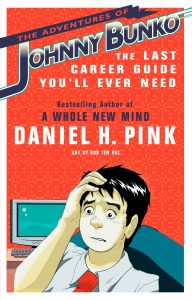
Voting has begun the Great Johnny Bunko Challenge – our groovy contest to find the 7th career lesson to accompany the six lessons Johnny learns in America’s first manga business book.
Over at the Johnny Bunko site, you can see a list of 50 intriguing entries.  And on the home page, you can vote on which of the three finalists deserves a place in graphic novel immortality.Polls will stay open until January 15, 2008.  Fear not: We’ve designed the ballot so it’s simple enough to avoid a Minnesota-style recount.* Great Johnny Bunko ChallengeÂ
About ten years ago, Masashi Kishimoto created the manga series Naruto, about a young ninja with a dark secret. The series has been monumentally successful, selling tens of millions of books and spawning its own media empire. In an LA Times interview, Kashimoto explains the appeal of this less-than-perfect lead character:
“Perfect heroes are cool, but no one can really empathize or identify with them. Naruto often makes blunders, and he has weaknesses. Naruto feels inferior to his peers, but he hates to be a loser. Although he doesn’t think about it too much, he knows he hates to lose, and we all know what that feels like. I think readers see themselves in Naruto, and that’s what appeals to them: They can empathize with him and his weaknesses.”
Alternet gleans several years of research from the field of positive psychology to reveal “10 Things Science Says will Make You Happy.” The list, paraphrased, is:
It’s worth reading the whole story.